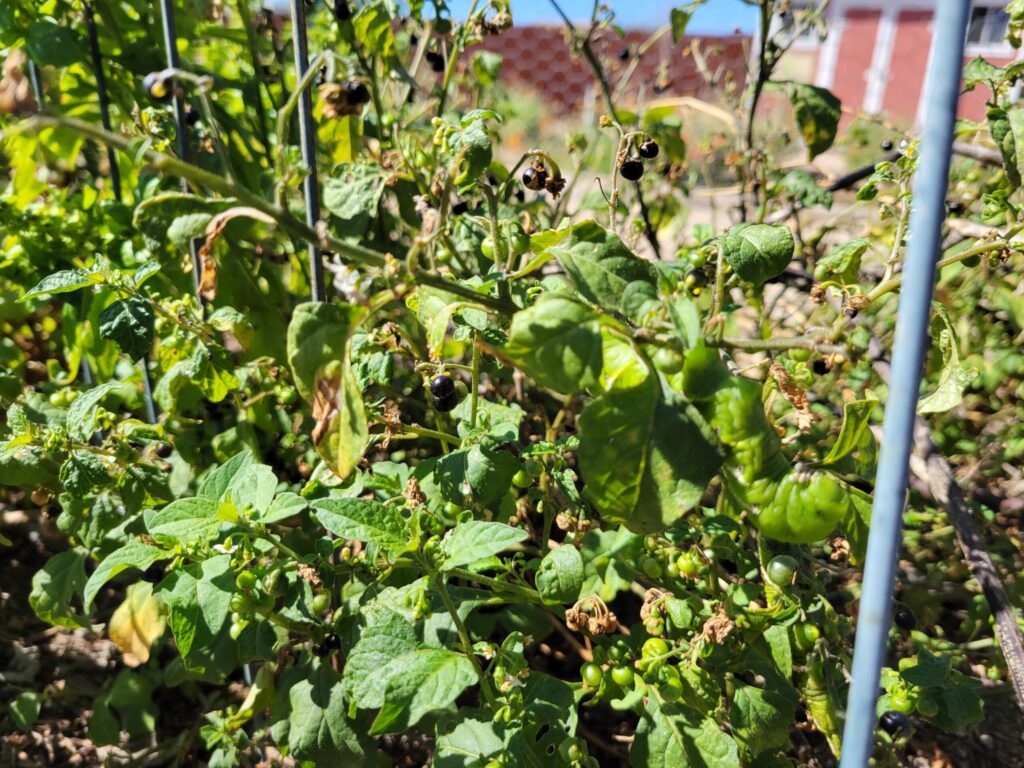

“When they’re black and shiny, they’re edible. It’s a mild flavor, but something you could survive on.” I am discriminating in my choice of which garden huckleberries to pick, demonstrating the resulting safety by popping one in my mouth, and training a fellow gardener’s eye to find more fruit. She likes it, asks if she can grow the plant in her own Marana Community Garden plot, and I hand her rooted specimens I had just pulled up. She happily offers tomatoes – green, best for frying, not eating fresh – in return. This shared human encounter, based on being able to tell plant traits apart, is one of many over the years that has rattled the word “discriminate” around in my head.
“Anti-discrimination” is important in my professional and personal world. The meaning of “discrimination” socially is about how we treat other people, not what we put in our mouths. A hurtful action, not a life-sustaining one. On the “anti-discrimination“ side, I include all walks of life who walk into Nature to You library programs, across Pima County. I continue to learn how diverse the Town of Marana is based on attendance at both public and private gardening events. Under my public school employee hat, I gather children of diverse ethnicities and abilities in a central Tucson garden four days a week. Peg me as “Pro-Diversity, Equity, and Inclusion”, and you are correct.
Personally, I will ever credit early friendships in Mesa with classmates and Girl Scouts from many cultures, with my understanding today in Tucson that different people have shared goals and cares for the world. My own children benefit from attending public schools and Scouting America troops with kids from diverse family backgrounds and beliefs. The challenge is a healthy one – and usually not a challenge at all.
So… Why is discrimination also important? At an evolutionary level, it aids in human survival in the form of finding food. Avoiding poison. Reading other humans’ intentions. Yes, predicting safety and even reproductive success. How can a gardener use the innate power to tell things apart, for good?
Harvesting safely
Look for warm-colored tomatoes, deep black huckleberries, bright red wolfberries. Within the family Solanaceae, wait until the fruit is NOT green to be on the safe side. What’s Solanaceae, you say? It’s the nightshade family, which does include true toxins in even the ripe fruit of some species. So, learn to identify the edible species, helped by observing traits of their fruits, leaves, and flowers. This helps you survive both in the garden and in the wild.
An unrelated fruit, pomegranate, provided an impactful elementary school lesson a few years back. The kids were eager to eat fruit that had ripened all summer. We quickly noticed that some fruit had holes bored by bugs or birds. Was is OK to eat the pomegranates anyway? We cut the fruit open. Some specimens were beautifully pink and white inside. Kids gasped in awe, impressed. Others were a mushy brown, invoking involuntary sounds of disgust. Even to the students’ untrained eyes, they could tell which fruit was good to eat and which was not. We sliced off the actual bug bites, popped the healthy pomegranate arils into a bowl of water to separate them from skin, and glowed in shared appreciation of the garden snack.
The taste of bitterness is also a natural example of discrimination. Lettuce that is fresh and easy to eat has a lightly sweet flavor. Lettuce that is bolting or about to is bitter. You want to spit it out because the chemicals inside have actually changed as the plant shifts into its next life cycle stage. Let it make flowers and seeds. Find another specimen or species in the garden to enjoy instead.
Weeding
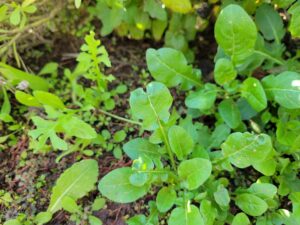
I have always enjoyed the task of weeding because of the therapeutic calmness, focus, and physical satisfaction it provides. I also continue learning about telling plants apart! Just last month, I thought I saw volunteer London rocket plants – an invasive mustard – in a raised bed of native Mexican honeysuckle. When the plant I pulled resisted my effort, my discriminating mind kicked in at a different level. Young mustard plants are usually easy to pull. This must be something else… The answer easily came when I spotted mature Mexican evening primrose in another corner of the same bed. The desired ground cover had spread, and until that day I did not realize how similar the leaves looked to the mustard I regularly pull as a weed.
Physical touch has influenced what I allow to grow versus go based on texture. I first encouraged any native flower in my backyard, and even used a gorgeous assortment in my wedding bouquets. I now pull up fiddlenecks and popcorn flower early because I know they will get super-scratchy later. I do allow some lusciously purple scorpionweed if it’s out of the way. In the Marana Community Garden, I have learned to pull up new sow thistles because the adults are tough and sharp. Is it ironic that the soft – and edible – mustard gets to stay for my students to sample? In your own garden and yard, you get to make your own choices for what counts as a weed.
Planting
When you plan a garden, you also have the power of planting a diverse mix of both food and flowers. By discriminating among brassicas (broccoli and cousins), alliums (onions), legumes (peas), and asters (sooo many flowers!), you can also choose to mix plants from multiple families. The differences are beneficial because they balance each other’s intake of nutrients from the soil. Plus, if a pest overtakes one plant it is less likely to spread to the neighboring, unrelated plant.
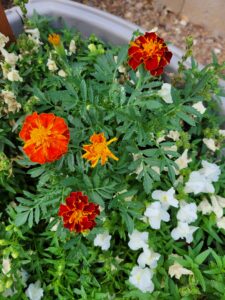
Other discriminating tastes are purely personal preference. Find you favorite flavors of brassica – I love broccoli buds, kale leaves, and kohlrabi’s modified stems. How much do you like to prep food? Personally, not much, so I select tomato varieties that are small for snacking and peas that are perfect for students to snap while still outside. Flowers are a lot of fun to eat – onion blooms are spicy and sweet, marigolds unapologetically floral, chuparosa more like cucumber. The more edible plants you can tell apart and identify, the more diversity to which you can treat your palate.
I share these musings today as a partial explanation – not excuse – for humanity’s harmful uses of discrimination. I also want to celebrate that differences can work for good. Adults and children alike delight in learning unique names, features, and uses for plants in the garden. Students who learn the shape of pea pods amid identically-colored pea leaves, or learn their own preference among varieties of onions, are learning skills of both discrimination and sustenance. And anyone can take out their stress – without hurting humans – on weeds in their own backyard or community garden. You might even befriend a neighbor in the process.